Claytonia Rocks!

So these plants are considered to be ‘geophytes’ because they have underground storage organs, but I find this so-called classification to be much more meaningful than that for the tuberous perennial Claytonia. In order to better understand this, let me break it down a little bit.

Phyte – Greek, generally referring to a plant.

Geo – Greek, generally referring to anything of or relating to the Earth.

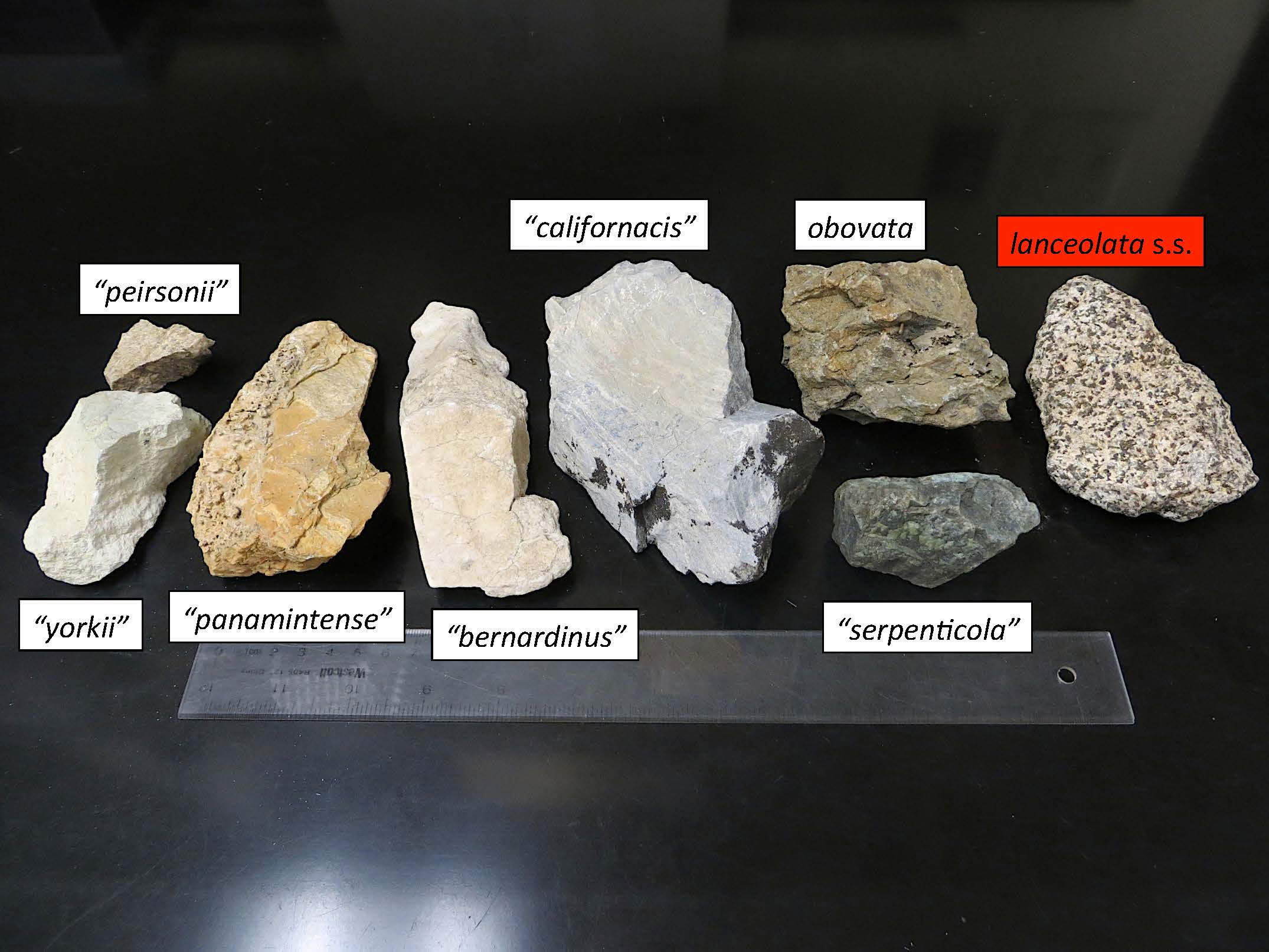
2013-05-30 11.44.33Pictured here is the habitat of the typical variety for the Claytonia lanceolata complex, C. lanceolata sensu stricto. At least in northern California, this taxon is known only from soils derived from granitic rocks. The suggestion has been that as a generalist, C. lanceolata (as currently circumscribed) occurs in a variety of habitat types across its range and thus is highly polymorphic morphologically. Well, there are some interesting substrates in southern California within very close proximity where one can find members of C. “peirsonii” complex occurring in nearly equivalent niche space across different substrates… Wait a second, am I studying geology or botany?!

2013-04-20 09.57.32Because bragging about how awesome the San Bernardino Mountains are is my favorite thing in the world to do, I’d like to take this opportunity to point to some interesting Claytonia there that occur on sedimentary carbonate rocks on the north slope of Bertha Ridge. This is the ridge that separates Big Bear Valley to the south from Holcomb Valley to the north. This is where I first encountered plants that match the description of Claytonia lanceolata var. peirsonii Munz&Johnston, or any plant treated as Claytonia lanceolata in the Jepson Manual or Flora of North America, while I was working as a Rare Plant Technician for the USDA Forest Service on the San Bernardino National Forest. More pictures of these plants can be found on CalPhotos.

IMG_9508These plants, as mentioned previously, are ridiculously cute (see related articles below and cast your vote!). More importantly for this story, these plants occur on dolomite, which is a particular type of carbonate rock containing the mineral dolomite.

2013-04-20 12.17.49And boy-howdy are these rocky hills STEEP! Unfortunately, this is an aspect of the habitat that many of the tuberous perennial species of Claytonia appear to have conserved across lineages, making field work incredibly physically demanding when sites are remote. But what is my point, exactly?

2013-04-20 14.20.56Pictured here, approximately 7 air-km to the north, there exists another population of tuberous perennial Claytonia that is primarily associated with the same species (Pinus flexilis, P. monophylla and Juniperus) but otherwise occurs on a different kind of carbonate rock than the population at Bertha Ridge. This becomes significant when you look at the morphology of the plants here, which is inconsistent with the plants at the Bertha Ridge population just 7 air-km away.

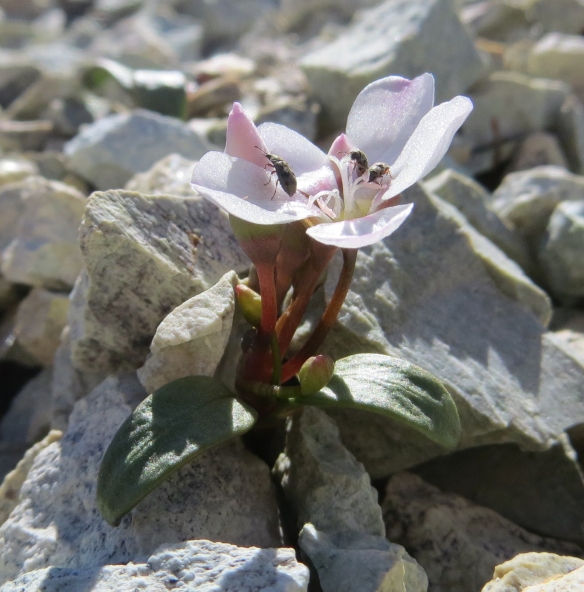
2013-04-20 14.21.55Not only do the plants at this more northern locality on gray dolomite have pink nectary guides, in contrast to the yellow spots at the base of the petals on plants from Bertha Ridge, but cauline leaf shape appears also to be strikingly different between these two populations. This interesting case of inconsistency in overall morphology, coupled with signs of genetic divergence among these populations (see my most recent phylogeny here), has gotten me very excited about patterns of evolution in this group that is already well known for complex histories of hybridization and polyploidy

ClaytoniaRocksAlthough it is all C. lanceolata for now, soon enough we’ll make some sense out of it!

Which is the cutest?

You’re really going to ask me which Claytonia I think is the cutest?! I find the entire genus to be cute… It’s a really tough choice!

Image

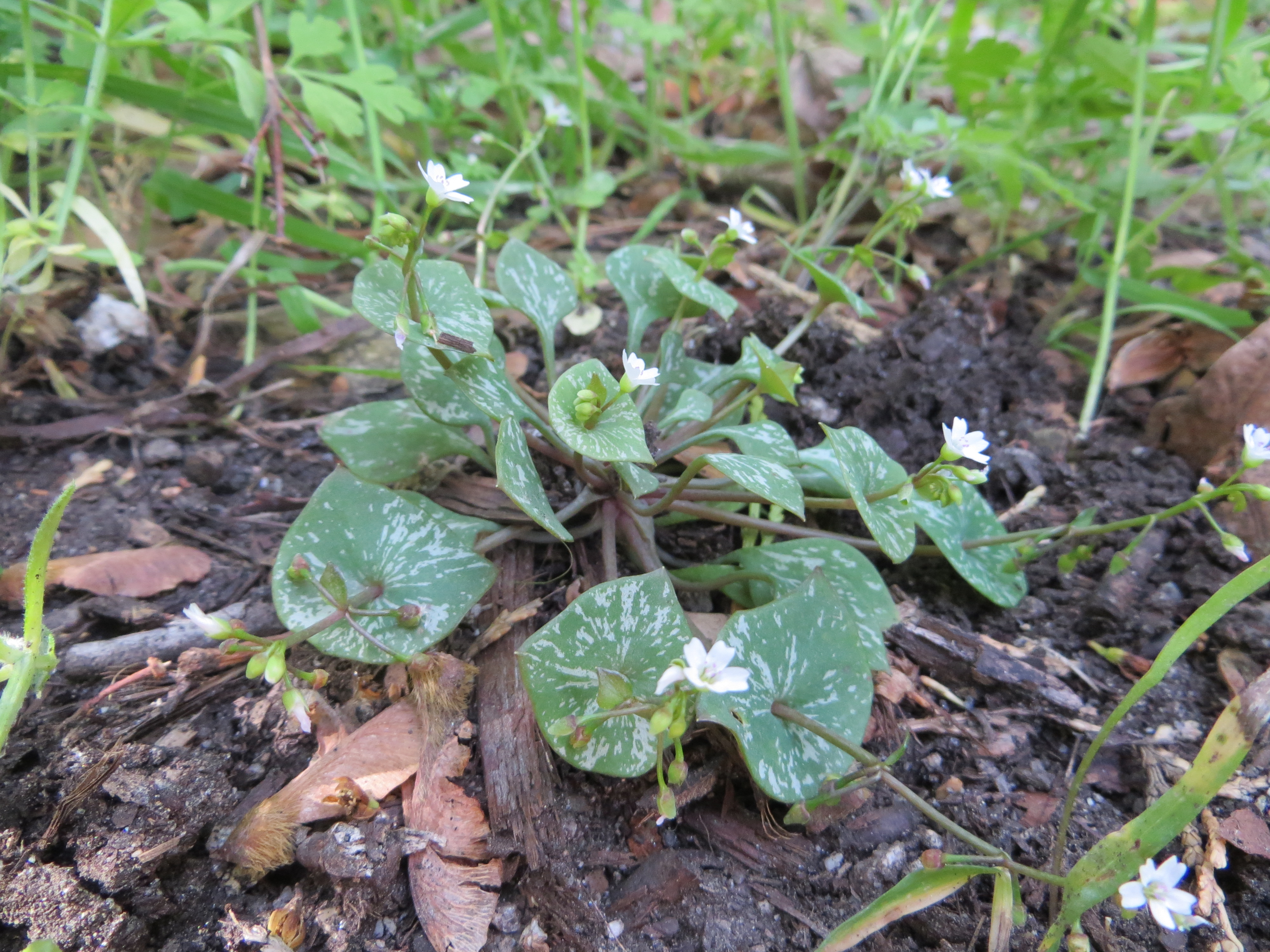
This one from the Southern Sierra is a real crowd pleaser, being found growing in talus of volcanic rocks (Tuff). It appears to be in the C. parviflora complex (C. perfoliata sensu lato), putatively a local endemic based upon evidence from morphology and patterns in tuberous perennial Claytonia in the area. Although not my all-time favorite Claytonia, this cute little annual always makes for an entertaining photo shoot.

Image

This member of the C. virginica complex is also quite stunning, being found on nearly every flood plain of the major rivers draining toward the U.S. Eastern seaboard (this one photographed in North Carolina). The reason it isn’t my favorite? Well, poison ivy (Toxicodendron radicans) also grows on nearly every flood plain draining toward the Eastern seaboard. What is the significance of this distribution you ask? Well, when I go collecting Claytonia and nearly everything else is un-identifiable due to the extremely early flowering season of Claytonia, I end up getting exposed to Toxicodendron a LOT! I now have a systemic reaction whenever I get exposed to Toxicodendron or any other member of the Anacardiaceae… so also when I eat mangos or cashews. I (used to) love mangos!!! Dang…

IMG_2674OK, now we are talking cute here… This thing took my breath away the first time I saw it in the North Coast Ranges of northern California, where it can be found on Franciscan Graywacke (a type of sedimentary rock). Formerly treated as C. obovata Rydb., this taxon is currently treated as C. lanceolata despite its morphological dissimilarity with the latter taxon. And You’re saying this isn’t the cutest?! Why not? Well, I think this little guy was ruined for me when some hooligans decided to start shooting various guns in the air very close to where I was. It was a bit scary, and I think it spoiled the good time I was having at the time ripping these beauties out of the ground (for the sake of science, of course).

Image

Now this one absolutely has to be the cutest, right? Wrong! It is cute, oh yes, but not the cutest. This beauty is just another narrow endemic that is not currently recognized (but hopefully will be soon!)… Levels of cuteness approach the maximum score, but this little beauty (only a few centimeters tall) just isn’t the cream of the crop. It grows in a crummy habitat (steep, loose talus of volcanic rocks), for one, and it also lives behind a locked gate in an area that is proposed for wind energy development. Until I find populations of this unique taxon outside of the Jawbone Canyon in the southern Sierra Nevada, it sits in the same category as the C. virginica complex because it comes with too much baggage… NEXT!

Image

Oh yeah! If you’re cute and you know it, be super small… This is the first member of the C. lanceolata complex I ever found (in the San Bernardino Mountains of southern California on white dolomite). You might say it is the reason I got into this mess in the first place, and thus it holds a special place in my heart. It is amongst the smallest members of what I am calling the C. “peirsonii” complex, a southern California species complex nested within the C. lanceolata complex (which truly is summarized as the ENTIRE clade of tuberous perennial Claytonia, e.g. Claytonia sect. Claytonia). It is very VERY cute, but still not the absolute cutest. Tough competition, right?! This is very close to my all-time favorite Claytonia, but there is one species that takes the cake…

Image

Wow! What a show-stopper! Claytonia saxosa is indeed the cutest Claytonia I have seen to date, but there may just be some species out there that are even cuter than this one, including yellow and pink-flowered tuberous perennial Claytonia that I hope to see in 2014. Until then, this is the cream of the crop, king of the hill, or whatever you want to call it. It is just dang CUTE! Also growing on Franciscan Graywacke in northern California (in close sympatry with C. obovata), this annual species is said to occur on serpentine rocks as well. I’m interested to see if the serpentine plants are really the same taxon, given what patterns have been observed in the tuberous perennials, but until I can get the material I must consider it the same species across its range. I guess I’ll just have to get out there and see it elsewhere… I recommend you get out there and see it too! Anthony Peak (Mendocino National Forest) in the North Coast Ranges of California has a healthy population that is ripe and ready for photographs in the month of May.

In order to get to the bottom of this, I encourage you to cast your vote! Cast your vote for more than one, whatever, but you can only vote once! I want to know if you agree, that C. saxosa is indeed the cutest of all Claytonia-land…

Evolution of Promiscuity in Angiosperms: Microryza Project

2013-06-23 17.53.12Hey all ya’ll! I am floating my research project on a crowd-sourced ‘kickstarter’ website in hopes to raise $20K for my research and I need your help to get the word out to everyone (feel free to RE-POST this message). I am posting to let you know that you have the opportunity to contribute any amount of funding to my research on rare, predominantly alpine plants and the effects of climate change on the montane flora of California and more broadly throughout North America. No donation will be charged unless I reach my goal, and all donations are tax-deductible!

My project page can be found here, and will be made publicly available next week for exactly 30 days of fundraising:

Evolution of Promiscuity in Angiosperms

I’d be happy to provide more information for anyone, and obviously would acknowledge all contributions large and small on my website and in publications. Thanks at least for listening!

I need your help to get the word out to EVERYONE so please RE-POST, Re-Tweet, Instagram, Facebook it, whatever you can do to help!

Claytonia rubra, what is that? pt. I

Possibly my favorite outgroup material, pictured here is Claytonia rubra, a widespread annual species that is a close relative of the group of tuberous perennials that I study. 2013-04-28 11.17.10

This species has been involved in a number of ’bouts’ of hybridization primarily with two other annual Claytonia (C. perfoliata and C. parviflora), making the identification of annual species in this group incredibly challenging. Polyploid lineages have been recognized as varieties for this species and others formerly treated as C. perfoliata sensu lato, creating what appears like a continuum of morphological variation in one ‘species’ resulting from recombination among three unique lineages (pictured below).

2013-04-28 11.34.01Why do they call it Claytonia rubra? Well, because it is REALLY RED on the abaxial side (bottom) of the leaves, a condition resulting from increased betalain production, aside from its darker green adaxial surfaces as seen in the first picture. Claytonia parviflora (left) with linear leaves and C. perfoliata (middle) with spatulate leaves are readily distinguished from C. rubra by this morphological character alone, but subtle floral features exist as well that can be used for this group, including petal shape.

2013-04-28 11.41.08Next spring, when you’re out hunting for melting patches of snow to see the pretty Claytonia that are in bloom next to them, be on the look out for ‘miner’s lettuce’ at slightly lower elevations than the tuberous perennials but still in areas of high moisture. Claytonia rubra is typically found in Mixed Conifer habitats, often in deep shade and at higher elevations than other members of the C. perfoliata sensu lato complex.

The C. perfoliata sensu lato complex (including C. rubra) is incredibly ruderal and can be found nearly anywhere in the montane habitats of California and the Southwest, making my choice to study the tuberous perennials seem a bit silly at times. Polyploidy seems to be intimately linked with the successful dispersal into new and disturbed habitats in this group, and it will be interesting to compare with the evolutionary patterns and relationships among the tuberous perennial Claytonia.

My first targeted Claytonia hike: Eastern San Gabriel Mountains

I was dropped off at the base of the ski lifts for Mt. Baldy Ski resort as the sun was rising over a gorgeous day in May of 2012. It happened to be a shuttle hike approximately 17.5 miles end to end in the Cucamonga Wilderness of the Angeles National Forest; another solo hike… I hope I’ll be able to find this little thing!

I climbed up as quickly as I could towards the ski runs under Thunder Mountain, where what was once treated as Claytonia lanceolata var. peirsonii is reported from the steep, forested ridges between the runs. I hadn’t seen these plants in the San Gabriel Mountains just yet, but by this time I had stumbled across a Claytonia in the San Bernardino Mountains two years prior that answered to the rather vague description of this taxon (var. peirsonii) while working for the USDA Forest Service.

Image

That’s it! North-facing slopes! It can be found blooming next to melting patches of snow in areas where there is also heavy accumulation of conifer litter, often with associated species such as Pinus lambertiana, Abies concolor, Pyrola dentata and Fritillaria pinetorum. I don’t see any snow over there, but it fits the bill otherwise!

Image

OK, not quite flowering, but it’ll do. I’ve got two more peaks to ‘bag’ before this day is done if I am to see more Claytonia on this hike. I set off toward Telegraph Peak, where I had to shimmy a bit off trail right over the edge of the north slope down to another historically collected locality for this rare local endemic.

photo copy 10A bit of snow around here, this is more like it! Now I’ve just got to find the little buggers flowering…

photo copy 18

What a beauty! Spring Beauty that is… now I just had to get back up to the top of Telegraph to grab the trail over toward Timber Mountain to complete the ‘Three T’s Hike’ I’ve heard so much about.

photo copy 23The north slope of Timber Mountain seemed to be the most ‘typical’ habitat based upon reports for Claytonia lanceolata var. peirsonii, with persistent snow patches as I had just seen over at Telegraph Peak. Sure enough, I was not disappointed by the beauties there!

photo copy 31I made it down to the trailhead around 6pm at Ice House Canyon, where my car had been hanging out all day waiting to hear the news about my big adventure.

“You’ll never believe me, WaSaabi, but I accidentally stepped right onto a rattlesnake’s head this morning. He didn’t seem too thrilled about it.”

If you’re going to hike 25 miles in one day, it better be worth it…

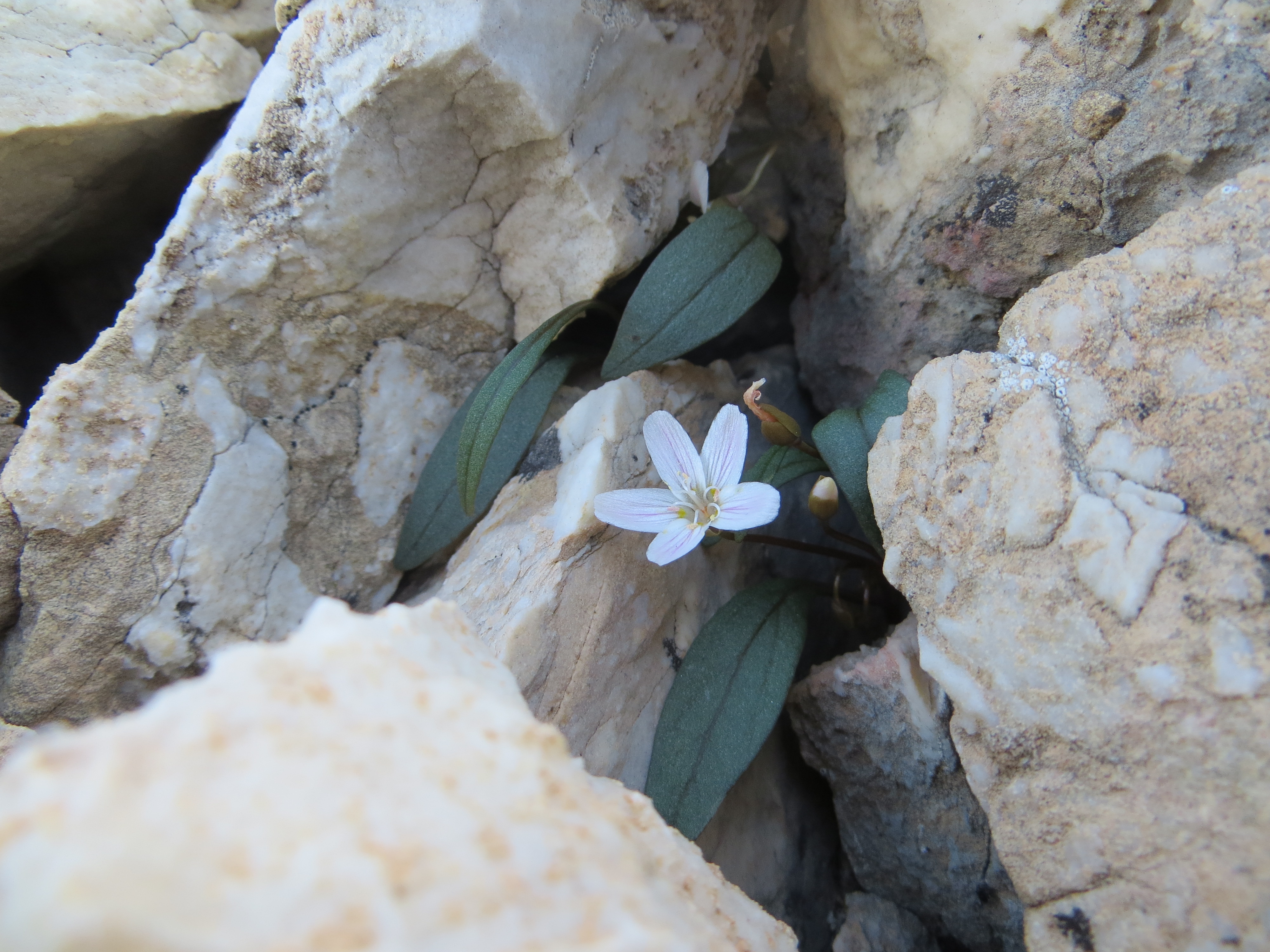
ImageThe utterly gorgeous Spring Beauty pictured here was a sight for sore eyes after I had a less than pleasant hike this day in March at Death Valley National Park. I drove past Badwater, the low point that most people are familiar with, and grabbed a dirt road that headed toward the Panamint Mountains on the west side of the valley in the direction of Telescope Peak. Little did I know that what I was expecting to be a well-graded dirt road turned out to be a 4-wheel drive only road, and my proposed 9 mile, 3500 ft gain and loss hike had just turned into a 25 mile, 7000 ft gain and loss hike if I wanted to see the Claytonia. Good morning from just above sea level!

Image

The road was long and grueling, with the trail being only slightly more forgiving. I made it up into the Pinyon/Juniper belt by the afternoon and I really started to feel good about the habitat I was seeing, but I was more than exhausted from the hike, and I had a rapidly approaching turn around time of 5pm. It’s got to be around here…

ImageMy 5pm alarm went off as I dug up the first couple of plants for voucher specimens. I had to work quickly and run down the mountain before dark set in too deeply, with my head on a swivel to watch for mountain lions. Did I forget to mention I was alone? I’ll definitely be back to this and other desert mountain ranges next spring in the very early spring months (Claytonia is often found blooming next to melting patches of snow). But next time, I’m bringing a truck! Long hike…

Image

no luck with Peirson’s rock cress

I went up to San Gorgonio Mountain last weekend with Diana Jolles (all pictures credit D.D. Jolles) to look for Boechera peirsonii at a locality it has not been found. We looked for it a bit south of Charlton Peak near (just below) Dry Lake View, accessed from Dry Lake. This sits on the west end of the bowl that was once a large glacier on the north slope of San Gorgonio Mountain, only a stone’s throw from the type locality for Boechera peirsonii.

DSC_6887We checked out this super sweet habitat, but didn’t find any Boechera peirsonii just below Dry Lake View, at the toe slope of the north face of San Gorgonio Mountain.

DSC_6890Not to say that we didn’t find any Boechera, we just didn’t find the one we were looking for! Looks like what we call Boechera platysperma in southern California needs some work!

Next week, cirque east of San Gorgonio Mountain above Mineshaft Saddle. Fish Creek Trail? Any takers?

Claytonia lanceolata species complex

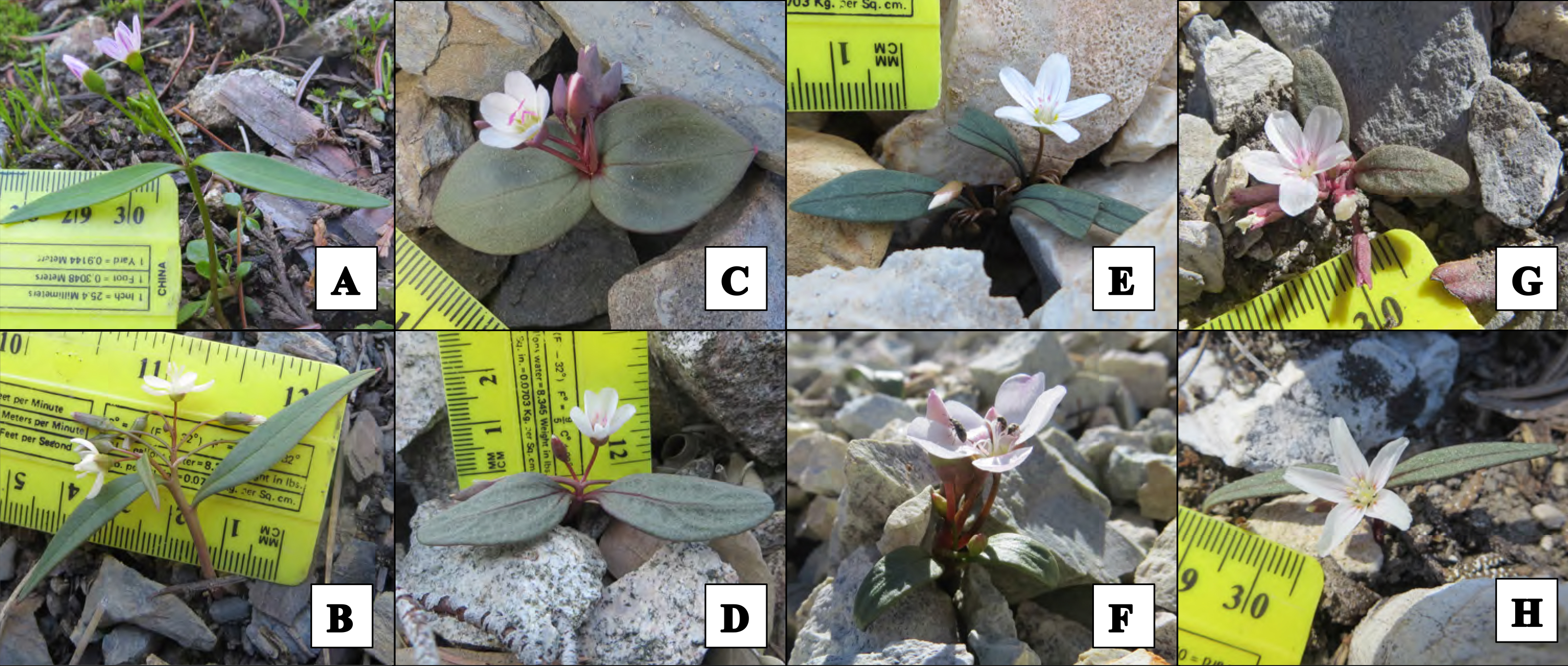
figure1The Claytonia lanceolata complex in California. In northern California, (A) Claytonia lanceolata Pursh on granite, (B) alternate-leaved and undescribed C. “serpenticola” on ultramafic rocks, and (C) an unrecognized taxon on greywacke that fits the description of C. obovata Rydb., unsampled in previous phylogenetic studies. In southern California, (D-H) The Claytonia “peirsonii” complex, with (D) var. “peirsonii” on granite in the San Gabriel Mountains near the type locality of C. lanceolata var. peirsonii Munz & Jtn. New discoveries in this complex within a species complex include (E) the long-petioled C. “peirsonii” var. “panamintense” in the Panamint Mountains on dolomite, (F) light pink-flowered var. “yorkii” on volcanic tuff in the southern Sierra Nevada, and two variants in the San Bernardino Mountains on (G) grey and (H) white dolomite at Furnace Canyon and Bertha Ridge, respectively.