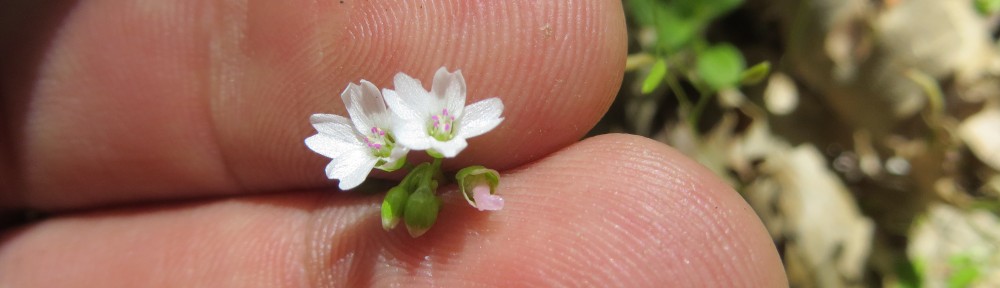
I am still thinking about pollination biology of the tuberous perennial species of Claytonia in southern California, which often have large flowers compared to the annual species in the area. I am making an effort to observe more pollinators this year after having so few observations in the last two years (see pt. I). I have yet to observe the same pollinator at any given locality in southern California for the five putative taxa in the C. “peirsonii” complex. What are they pollinated by? To me, it is all very interesting stuff and I’m happy to take what I can get here and there… but my collaborator Diana Jolles (credit all photos) set out on our previous hike to shoot as many pollinator photos as possible so we might get to the bottom of this. Thanks to Diana’s efforts, we are gathering more clues about who may be pollinating the tuberous perennial Claytonia of southern California, this time from the San Gabriel Mountains populations.

The insect visiting the Claytonia flower above is a Greater Bee Fly (Bombylius major), a member of the Bombyliidae. It was spending a lot of time visiting each flower: what a fuzzy fly!


Pictured above are some of Diana’s photos from our first observation of a solitary bee visiting any tuberous perennial Claytonia in southern California. This gorgeous, green, metallic organism is a member of the genus Osmia (orchard bees) in the Megachilidae. These are in the running for the coolest looking native bees in California in my book. Such amazing coloration!


Lastly, above are Diana’s photos of a third insect visitor seen on February 15th, 2014 near the Devil’s Punchbowl County Park. This dark butterfly is a Duskywing (Erynnis), a member of the Hesperiidae (skippers). It was hard to get a shot as the butterfly hardly seemed to want to sit still, but Diana managed to sneak in a few good ones — thanks so much for all the pictures! I’d like to thank also one of my collaborators, Dr. Emile Fiesler, for identifications of these beautiful pollinators. I hope we can make more pollinator observations this year for all of the members of the C. “peirsonii” complex. Still no overlap in pollinators observed among the members of this southern California species complex, a group currently included in the broad circumscription of Claytonia lanceolata!



 Claytonia.org